Upgrades
Aging-in-Place Kitchen Modifications: Options, Costs, Who Pays
Lowered counters, pull-out shelves, side-opening ovens, lever handles, lighting and induction cooking: what each fixes, what drives the price, and who pays.
Updated 2026-07-08. Reviewed against our editorial standards.
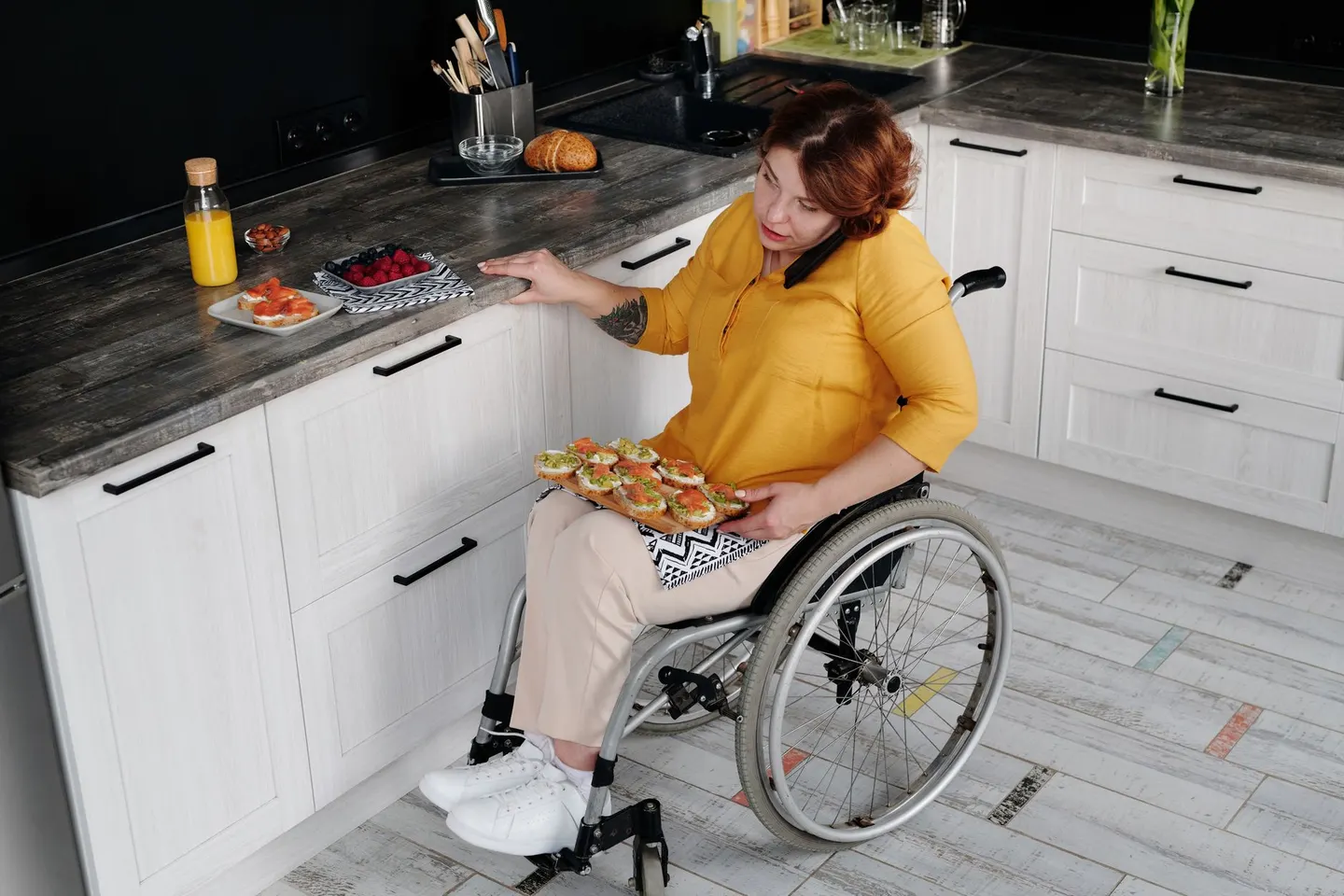
Kitchen modifications for aging in place range from an afternoon of new handles and brighter bulbs to a full remodel with lowered counters and a roll-under sink. The most useful changes, in rough order of value for money, are better lighting, lever and D-pull handles, pull-out shelves in the lower cabinets, a single-lever faucet, an induction cooktop in place of gas or coil, and a wall oven at counter height with a side-opening door. Lowering a counter or adding knee space comes last because it usually means new cabinets, and it matters most for someone who cooks seated.
Ready to talk to a certified aging-in-place remodeler? Tell us how the kitchen is used today and a certified aging-in-place remodeler serving your area will reach out once matched: get matched for kitchen modifications.
What it is and who it is for
The kitchen is where an older adult reaches, lifts, bends, carries hot things and stands on a wet floor, often alone. Aging-in-place kitchen work removes those hazards one at a time:
- Lighting. Bright, even light over the counters (under-cabinet strips), the sink and the stove.
- Handles. Lever handles on doors and faucets, D-shaped pulls on cabinets. Arthritic hands cannot grip a round knob.
- Storage you can reach. Pull-out shelves and drawers in the base cabinets so nothing lives at the back of a dark cupboard.
- Cooking without flame. An induction cooktop heats the pan, not the surface, has no open flame, and usually shuts off on its own. A microwave at counter height, so hot food is never lifted overhead.
- Ovens. A wall oven mounted with the rack near counter height and a side-opening door, so a hot dish slides sideways onto the counter.
- Counters and sink. A section of counter at seated height with open knee space, and a shallow sink with insulated pipes, so a wheelchair can roll under.
- Floor and doorway. Slip-resistant non-slip flooring and a doorway wide enough for a walker or chair (see widened doorways and hallways).
This is for anyone who cooks and is unsteady, has a weak grip or low vision, uses a walker or chair, or has a memory condition where a forgotten burner is the family's biggest fear. Ask the occupational therapist or doctor what the person can do safely in a kitchen before you design around it.
Safety refresh versus full remodel
The decision that sets the budget:
| Safety refresh | Full accessible remodel | |
|---|---|---|
| Layout | Unchanged | Counters lowered, knee space added, appliances relocated |
| Cabinets | Kept; pull-outs and new pulls added | Replaced or rebuilt |
| Plumbing and electrical | Faucet swap; cooktop swap if the circuit is adequate | Pipes and circuits moved; new dedicated circuits |
| Permits | Often none, or an electrical permit only | Building, electrical and plumbing permits |
| Time | Days | Weeks |
A refresh handles the hazards for most people who still walk. A full remodel is for someone who cooks seated.
What it costs and what drives the price
No trustworthy national range exists for aging-in-place kitchen work, so we give drivers, not dollars. Get 3 written local quotes with the same scope. The price rises with new cabinets instead of retrofits; moving the sink, cooktop or oven; a new dedicated circuit for induction; stone counters; the size of the kitchen; and permits. It falls when the layout and counters stay and the work is handles, lighting, pull-outs, a faucet and a cooktop swap.
Who pays
Most kitchen work is paid directly by the family, a respectable path with real advantages: no pre-approval, your choice of appliances and cabinets, and you can start this week. Our paying out of pocket guide covers savings, a home equity line, a reverse mortgage for homeowners 62 and over, contractor financing, and sibling agreements.
The other channels, honestly:
- Original Medicare does not pay for kitchen modifications. Some Medicare Advantage plans add a small safety allowance; kitchen work is rarely covered. See Medicare and Medicare Advantage.
- Long-term care insurance home modification benefits are tied to the insured's need for help with activities of daily living. Kitchen changes are a harder case than a bathroom, because the policy may not count cooking as one of those activities. Call the carrier before buying anything. See long-term care insurance.
- Medicaid waivers in some states cover home accessibility adaptations for people who qualify financially and medically. See Medicaid waivers.
- Veterans: the VA HISA grant pays for medically necessary alterations prescribed by a VA clinician, and lowered counters for a wheelchair user are the kind of change it is meant for. See VA grants.
- Taxes: a modification made for medical reasons can be a deductible medical expense under IRS Publication 502, only to the extent it does not add value to the home. A full kitchen remodel usually adds value, so only the clearly medical part may count. See tax deductions.
How long it takes and what to expect
Varies by home and region. A refresh is usually a matter of days, spread over a few visits from an electrician, a cabinet shop and a handyman. A full remodel runs weeks, and the kitchen is out of service for much of it. Plan where meals happen in the meantime. Appliances with long lead times (wall ovens especially) should be ordered before demolition, not after.
What to look for in a remodeler
Look for a Certified Aging-in-Place Specialist (CAPS), the National Association of Home Builders designation created with AARP, and expect them to ask how the person cooks before they open a catalog. CAPS is training, not a license, so confirm the state license and insurance separately. Tie payments to milestones and never pay in full up front. The full checklist is in how to choose an aging-in-place remodeler. If the kitchen is one of several worries, a whole-home safety assessment first will tell you where it ranks.
Florida notes
In Florida, electrical and plumbing work need their own DBPR licenses, separate from the general, building or residential contractor license that covers structural work, so a full kitchen remodel can involve 3 licensed trades. Verify each at the DBPR license search. Handyman work without a license is limited to non-structural tasks, which in practice means pulls, pull-out shelves and similar, not a new circuit for induction. Most Florida homes are single-story, so the kitchen is already on the level where the person sleeps; the common gaps are a slick polished-tile floor and a dim ceiling light. See our Florida page.
Ready to talk to a certified aging-in-place remodeler? Share what the kitchen needs and a certified aging-in-place remodeler serving your area will reach out once matched: get matched for kitchen modifications.
Questions people ask
What is the safest stove for an elderly person?
An induction cooktop is the usual recommendation. There is no open flame, the surface heats the pan rather than itself and cools quickly, and most models shut off on their own when a pan is removed or after a set time. Ask the doctor or occupational therapist whether unsupervised cooking is safe for the person.
How high should kitchen counters be for a wheelchair user?
Lower than a standard counter, with open knee space underneath so the person can roll in and work facing the counter. The right height depends on the person and the chair, which is why an occupational therapist's measurements are worth getting before cabinets are ordered.
Can I make a kitchen safer without a full remodel?
Yes. Swapping knobs for lever and D-shaped handles, adding pull-out shelves inside existing cabinets, installing a single-lever faucet, improving lighting and replacing the cooktop with induction can all be done without moving a wall or a pipe.
Does Medicare pay for kitchen modifications?
Original Medicare does not pay for kitchen remodeling or any home modification. Some Medicare Advantage plans offer small safety allowances, mostly for bathroom items, and kitchen work is rarely covered. Read the plan's Summary of Benefits.
Is a side-opening oven worth it?
For someone who sits to cook, or who cannot safely lift a hot dish over a drop-down door, yes. A wall oven mounted at counter height with a side-hinged door lets the cook slide a dish straight across to the counter.
Free, no obligation
Tell us about the home. We match you with a certified aging-in-place remodeler.
A few questions about your project. We never charge homeowners, and we never sell your information.