Upgrades
Stair Lift Cost: Straight, Curved and Outdoor Lifts, Who Pays (2026)
A stair lift costs $3,000 to $20,000 installed, averaging $7,000 to $8,000; straight rails are far cheaper than curved. Rentals, used lifts, and who pays.
Updated 2026-07-09. Reviewed against our editorial standards.
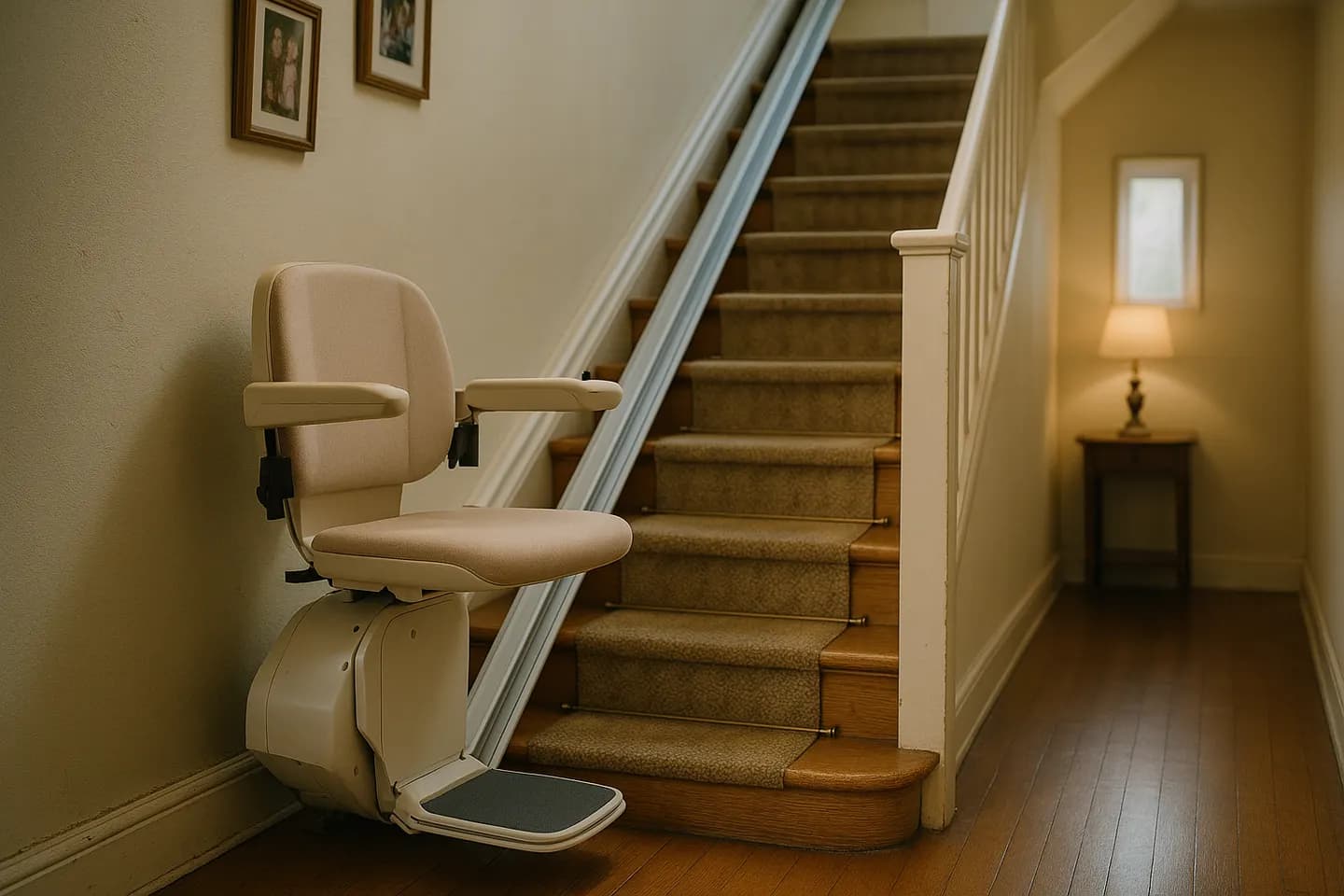
A stair lift is a motorized chair that rides a rail bolted to your stair treads, carrying 1 person up and down while seated. Installed, the national range is $3,000 to $20,000, with averages of $7,000 to $8,000; a straight rail is far cheaper than a curved one, and curved or outdoor rails sit at the expensive end. Rental and used straight lifts exist for short-term needs. These are national estimates from 2022 to 2026 secondary sources, so get local quotes.
Ready to talk to a certified aging-in-place remodeler? Tell us about your stairs and a certified aging-in-place remodeler serving your area will reach out once matched: get matched for a stair lift.
What a stair lift is and who it is for
The rail fastens to the treads, not the wall, so it works with almost any staircase. The chair has a seat belt, arms and a footrest that fold up when not in use, a swivel seat at the top so you step off onto the landing rather than the stairs, and a remote so the chair can be called from either floor. Most run on batteries that charge from a normal outlet, so a short power cut does not strand anyone mid-stair.
It is for someone who can sit down and stand up with little help but can no longer manage the stairs safely, usually because the bedroom or the only full bath is upstairs. It is not for someone who cannot transfer out of a wheelchair; for them, look at a vertical platform lift or home elevator. Some families skip the stairs entirely with a main-floor bedroom and bath. Ask the occupational therapist or doctor which fits.
Straight, curved and outdoor stair lifts
| Type | Fits | Price position | Lead time |
|---|---|---|---|
| Straight | 1 straight run, no landings | Low end of the range | Days; the rail is cut to length from stock |
| Curved | Landings, turns, spiral stairs | High end; the rail is custom-built for your staircase | Weeks for fabrication |
| Outdoor | Porch, entry or deck steps | High end; weather-rated motor, rail and cover | Days to weeks depending on type |
A straight lift is the common case and the cheapest. A curved lift is measured with photos or a laser scan, built for your exact stairs, and cannot be reused in another house. An outdoor lift uses sealed components and a cover, and matters in Florida for raised coastal homes and front steps.
What a stair lift costs
The range is $3,000 to $20,000 installed, averaging $7,000 to $8,000 nationally. What moves the price: straight versus curved, rail length, a powered swivel seat, a folding rail at the bottom so it does not block a doorway, a heavier weight capacity, outdoor rating, and an electrician's visit if there is no outlet near the stairs.
For a short-term need, such as recovery after a hospital stay, straight lifts can be rented, and used straight lifts are sold by dealers and private sellers. A used curved rail almost never fits another staircase. Whatever you choose, get 3 written quotes that name the model, rail type and options. If you are planning around a discharge date, our hospital discharge home prep guide covers the timing.
Who pays for a stair lift
Most stair lifts are paid for directly by the homeowner or family. That path has advantages: no pre-approval, your choice of dealer and model, and installation as soon as the rail arrives. See paying out of pocket for the tools people use, from savings to a home equity line to siblings splitting the cost.
- Original Medicare does not pay for stair lifts. Medicare Advantage coverage of structural modifications is rare; check the plan's Summary of Benefits.
- Long-term care insurance commonly lists stair lifts under its home modification benefit when the insured needs help with daily activities. Expect pre-approval, clinician documentation and a dollar cap.
- Medicaid waivers cover certain home modifications in some states when they are in the care plan. Waitlists exist.
- VA grants: the HISA grant does not cover stair lifts (the VA lists stair glides and porch lifts as exclusions). Ask the VA clinician whether the VA can provide one another way; the answer depends on the veteran's eligibility.
- Tax deductions. A stair lift adds little or no value to a home, so most of its cost can count as a medical expense when installed for medical reasons and you itemize.
How long it takes and what to expect
A straight lift is measured, ordered, and usually installed in a single visit. A curved lift takes weeks of fabrication, then a day or so to install. Expect the installer to need a working outlet near the stairs, to show the rider how the seat belt, swivel and remote work, and to explain battery care and the service plan.
Other people still use the stairs, so ask how much width the parked chair leaves and whether a folding rail is worth it. Someone with poor balance may need help getting on and off at first. Ask the occupational therapist about the transfer before you buy.
What to look for in an installer
Buy from a dealer who installs and services what they sell, and ask what happens when the lift stops working on a Sunday. Ask for the Certified Aging-in-Place Specialist (CAPS) designation from the National Association of Home Builders; CAPS is training, not a license, so also check the state license, insurance and the warranty on the motor, rail and battery. The quote should name the model, rail type, options, and removal terms if it is a rental. Never pay in full up front. Our guide to choosing an aging-in-place remodeler has the questions to ask.
Florida notes
Many Florida homes are single-story, so the stairs that matter are often outside: raised coastal homes on pilings, townhouses, and front steps. An outdoor lift there faces sun, salt air and heavy rain, so the weather rating and cover matter, and battery backup covers the brief outages of storm season. Any electrical work, including a new outlet at the stairs, needs a Florida DBPR-licensed electrician; verify at the DBPR license search. Florida has the highest share of residents 65 and over of any large state (21.8% in 2024), and stair lift dealers are easy to find in Tampa Bay and South Florida.
Ready to talk to a certified aging-in-place remodeler? Describe your staircase and who will ride, and a certified aging-in-place remodeler serving your area will reach out once matched: get matched for a stair lift.
Questions people ask
How much does a stair lift cost installed?
National estimates from 2022 to 2026 sources put a stair lift at $3,000 to $20,000 installed, with averages of $7,000 to $8,000. A straight rail is far cheaper than a curved one, and outdoor rails sit at the high end. Get local quotes.
Can you rent a stair lift?
Yes. Straight stair lifts are widely available to rent for short-term needs such as recovery after surgery. Curved rails are custom-built for one staircase, so they are rarely rented.
Does Medicare pay for a stair lift?
No. Original Medicare covers some durable medical equipment such as walkers and hospital beds, but not stair lifts. Long-term care insurance, Medicaid waivers and VA grants can help in some cases.
Can a stair lift work on stairs with a landing or a turn?
Yes, with a curved rail built for that staircase, which is the expensive option. Some families install 2 straight lifts, 1 per run, and transfer at the landing; ask the installer and the occupational therapist whether that transfer is safe for the person.
How long does stair lift installation take?
A straight lift is usually installed in a single visit once the rail arrives. A curved rail is measured, then built for your stairs, which takes weeks, followed by a day or so to install.
Does a stair lift damage the stairs?
The rail bolts to the stair treads, not the wall. Removing it leaves small holes that are easy to patch, and a used straight rail can often be resold.
Free, no obligation
Tell us about the home. We match you with a certified aging-in-place remodeler.
A few questions about your project. We never charge homeowners, and we never sell your information.